the "good old days" were complicated as hell.
I watched the recent Fantastic Four movie this past weekend with my 12-year-old son while my wife was at a baby shower, and I have to admit the movie's retrofuturistic setting was really really damn cool to see as a typewriter salesperson and repairman. It was like looking at a world designed by Dreyfuss in the same aesthetic as his famous Royal Quiet De Luxe. The retrofuturistic mid-century modern meets The Jetsons aesthetic is something that I think a lot of people feel nostalgic for.
And that's honestly true whether or not you grew up in the 1950s when those things were commonplace. I mean, they've become part of our cultural heritage in all kinds of ways. So as a result, I think a lot of us feel nostalgic for a version of the past that's encapsulated in movies like Grease or Back to the Future or shows like Happy Days. We know the diners, the cars, the clothes, the chrome. We know the red roofs and the neon lights. And, obviously, we know the typewriters.
I naturally understand the attraction. People can look at an old typewriter and feel something, and I feel it too, which is why I fix and sell these machines. But frankly, those versions of 1955 are showing 1955 through rose-colored glasses. We know that the situation for many people in 1955 was not substantially better than the situation in 2026, and thank God that we don't still live seventy years ago...
The typewriters really were that good. America? America emphatically was not.
Some Things Really Were Better
I don't want to do the easy thing and say nostalgia is stupid or that everything sucked in 1955, because I don't believe that. There are things about that period I think we absolutely ought to be nostalgic for.
Put a good Olivetti Lettera 22 from the 1950s in front of me and I can show you one.

There's something about these machines that goes beyond metal versus plastic or old versus new. I think the 1950s represented an almost wholly non-cynical approach to creation and ingenuity that we lack today. Somebody sat down and decided to make a really good typewriter. That really good typewriter was the objective.
Because every stupid little lever inside the thing exists to solve some particular problem. The ribbon needs to advance and eventually reverse. The carriage needs to move exactly one space every time you press a key. The bell needs to ring at the right place. The margins have to work. The platen has to advance the paper when you pull the return lever. There are hundreds of pieces in there working together for the sole purpose of putting words onto paper.
And somebody, at some point, expected the thing to last.
That expectation created an entire ecosystem around itself. There were dealers and repair shops and skilled mechanics and replacement parts. If the machine stopped working, the assumption was that somebody would fix the thing. Nobody was going to explain that your Royal had reached end-of-life and would no longer be receiving security updates.
This wasn't just true for typewriters. Mid-century America had an enormously stronger labor movement than we have today. There was serious public investment.
Schools taught shop, drafting, typing and home economics alongside reading, writing, arithmetic, music and art. There was a concept of a full, well-rounded education that included knowing how to build something and knowing how to read something.
Obviously, not everybody in 1955 was enjoying all of this equally. Millions were deliberately excluded from the prosperity we're remembering, and race had an enormous amount to do with who got access to it. (A Royal Quiet De Luxe wasn't a trivial purchase for an ordinary family, either.)
But I don't think it's reactionary to look at any of that and say, yes, something was lost. Something was lost. I can show you some of it. It's sitting on my workbench.
The problem is that I think we're nostalgic for the wrong things.
The Red Roof and the Gray Box
Think about McDonald's.
Twenty-five to thirty-five years ago, a McDonald's was a familiar, uncommon shape and color and theme for a restaurant. And those features were built right into the restaurant's architecture. Things like PlayPlaces, the golden arches, those red roofs that they used to have. Everything about the design of the building was McDonald's.
Today McDonald's restaurants are gray boxes.

There are practical and economic reasons for that; after all, standardized, simplified architecture has practical and economic advantages. Now I'm not pretending McDonald's architecture is the greatest crisis facing America. But the old building was designed to be a McDonald's. The new building efficiently contains one. That's a massive philosophical difference.
Well, the same thing happened with typewriters.
Think about the beautiful Quiet De Luxe we've referenced becoming, eventually, a flat, square, plastic box. Oof. What changed?
The company changed hands a bunch of times. Each company had a different vision. The design philosophy changed with each new vision. Economics changed. Consumers changed. Foreign competition changed the market. Plastic made machines cheaper and lighter. Electronics eventually changed what people expected a typewriter to be.
I'm not claiming there was one uninterrupted assembly line where Royal removed one good part every year until there was nothing left but a shitty plastic typewriter. That's not what happened. But look at an American Royal Quiet De Luxe from the 1940s or '50s. Pick the thing up. Feel the weight of it. Open it and look at the absurd collection of metal parts doing their little jobs. Then look at what the words Quiet De Luxe could eventually be pasted onto.
Something dramatic changed.
And nobody had to sit in a boardroom twirling his mustache saying, "How can we make this thing worse?" Every individual decision can make perfect economic sense. Save money here. Simplify this mechanism. Use a cheaper material there. Compete with the cheaper machine across the aisle.
Do that enough times and eventually you can wind up with something worse without anybody ever having made "worse" the objective. It's capitalism's Ship of Theseus: everything original about the thing was replaced. Can it really be said to be the "same thing"?
Because economics made it easier to make a typewriter good, then cheaper to make the easier machines, then cheaper became the only objective and the idea of good died on a tattered ribbon at the end of a page.
And sure, capitalism "made" the good Royal, too. Planned obsolescence was already around. But the economic system could produce something absolutely wonderful and then reward a hundred perfectly reasonable decisions that made the next thing cheaper, and the next one cheaper still, until nobody quite remembered why making the thing good had been the point.

Which brings me to an uncomfortable reality about being a consumer in today's fast-and-cheap late-capitalist hellscape.
We want the red roof. We believe in the gray box.
We're Nostalgic for the Wrong Things
So let's say we really could make America 1955 again. What exactly are we bringing back?
Do you want the stronger labor movement? I'm listening. Do you want an economy in which skilled tradespeople can make respectable livings repairing things rather than throwing them away? Hell yes! Do you want durable consumer products, investment in public goods, shop class, music and art, local businesses, and an ordinary family having some reasonable expectation that doing everything basically right will result in some degree of economic stability?
I'm not going to argue with any of that.
And I don't want to dismiss the social part of the nostalgia either. Communities really have changed for the worse due to the alienation that came from technological achievement. People are lonelier than ever even as they're more connected than ever. Families are scattered. There's something genuinely sad about living in a country where I can have basically anything delivered to my front door tomorrow and still not know the person living three doors down.
But the America of 1955 that we're mourning was also steeped in homophobia, racism, misogyny, crippling substance use disorders, etc. Brown v. Board of Education was barely a year old. Jim Crow was alive and well. The federal government was purging gay employees. Women faced perfectly legal and perfectly ordinary forms of economic discrimination that would be unthinkable today.
The right loves to talk about how there was more "common sense" way back in the day, or how people weren't as easily offended, or how political differences didn't divide everybody the way they do now. Sure, maybe there's something to some of that. But I would caution that it's considerably easier for everybody to agree about how society ought to work when enormous groups of people have been told to shut up.
So I don't think for even a moment that people were magically less offended. I think a lot of the people being marginalized had considerably less power to say anything about it.
And yeah, being a fascist was a lot easier when the people you wanted beneath you had fewer tools for objecting to the arrangement.
I'd love some of the community back. I don't think getting it back requires anybody to return to the closet.
So if they're remembering the racism and homophobia and misogyny and all the rest as part of the America they long for, then miss me with that America. It had its chance and failed, so fuckity-bye.
It's not an America worth missing.
Who Killed the America Worth Missing?
The parts of America worth preserving that have died off have died off for a lot of complicated reasons, but largely among them is a never-ending demand for a cheaper product at all costs under capitalism.
And this is where I become considerably less patient with the political right, because everything is the fault of "the left." I hear them blaming the left and I really only hear them blaming the left.
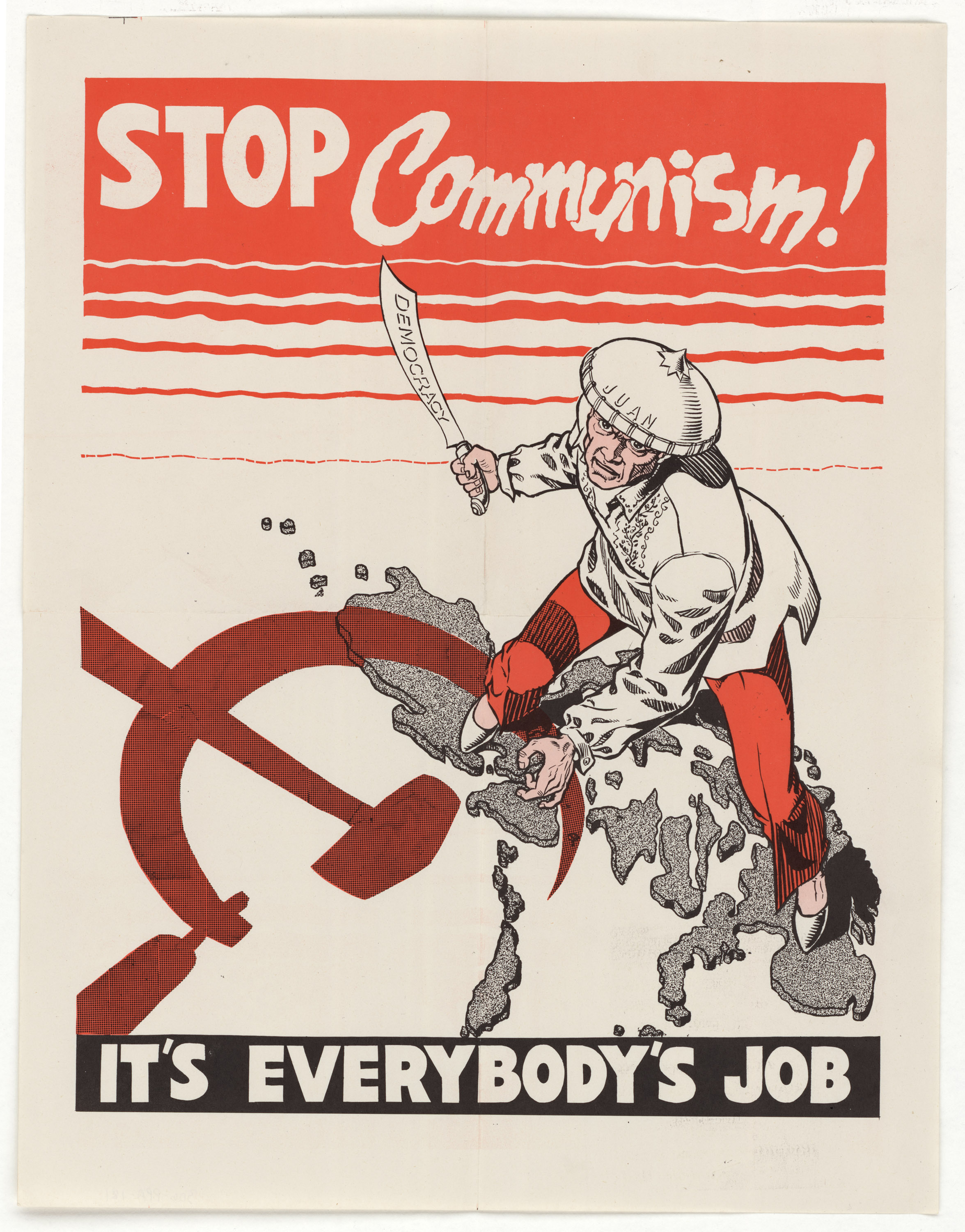
Crime is the left. Schools are the left. Cities are the left. Drugs and homelessness are the left. The breakdown of the family is the left. Whatever the problem is, we've reached a point where the idea of truth itself can be discarded in favor of saying the thing the loudest regardless of its relationship to the facts.
Crime is a good example. We're repeatedly told that America has descended into some unprecedented state of lawlessness even though the country's murder rate has fallen to levels comparable to the mid-1950s (and dramatically below the rates Americans lived with during parts of the 1980s and early 1990s). That doesn't mean crime isn't real. It means the story we're telling about crime ought to have some relationship to what crime is actually doing.
The same thing happens when we talk about what destroyed the material world we're supposedly nostalgic for. The left didn't turn the Royal Quiet De Luxe into a plastic box. Gay people didn't kill the repair shop. Feminism didn't make McDonald's gray. Immigrants didn't invent planned obsolescence.
Obviously deindustrialization is more complicated than "capitalism did it." Technology changed. International competition changed. Consumer preferences changed. Globalization made some things dramatically cheaper, and there are real benefits to that.
But there has also been a never-ending demand for cheaper labor, cheaper materials, cheaper construction, and cheaper products. Organized labor became an obstacle to be overcome. Repairability became less important when replacement became cheap. Manufacturing could move wherever labor cost less. The question of whether something was good increasingly had to compete with the question of whether it produced a required return.

And then we figured out there was even more money to be made if you didn't really own the thing at all. We'll sell you only the access to it. We'll sell you a subscription. We'll license it. We'll make it difficult to repair. We'll stop supporting it and sell you the next one.
Ronald Reagan personally did not turn my Royal into a plastic box. That's not the argument.
Because the right is not alone in a diseased and crippled political system, although the modern right has done an enormous amount to hasten that system's demise. The political movement promising to restore the old America has correctly perceived some of its losses while defending many of the economic priorities that helped produce them.
They want the red roof and they believe in the gray box.
Returning to God...?
Then there's Christianity. This one bothers me particularly, and I think it gets at the same distinction I've been making about the typewriter all along.
For example... I don't believe an old Royal has to be returned to exactly the condition it occupied in 1955 in order to preserve what was good about it. In fact, that would be ridiculous. I want the machine to survive. I want it to work. I want to preserve what was beautifully designed about it. But I don't need to reproduce every condition that surrounded it in 1955 in order to accomplish that.

Christian nationalism seems to make exactly that mistake.
When Christian nationalists talk about America "returning to God," I don't think what they're primarily mourning is Christianity. It's political and social power. It's a control-of-the-culture question. They aren't merely asking that Christianity be preserved. They're asking for a particular relationship between Christianity and the rest of American culture to be restored.
And that's an important difference.
Christianity has unequivocally lost enormous parts of the culture war at this point but has refused to move on. Americans did not return to traditional Christian sexual ethics. Gay people did not go back into the closet. Women did not return to the social roles conservative Christianity prescribed for them. The country became less Christian and considerably less interested in allowing Christianity to set the rules for everybody else.
That doesn't mean Christianity disappeared or became politically powerless; in fact, in some ways the opposite happened, and I don't think that's an accident. Christianity made its argument to the culture, and on quite a few questions the culture said no. That's allowed to happen in a democracy. Losing an argument is not persecution.
But the political currency was power, and that translated into unfathomable amounts of currency currency, so why would they move on? Everything over the past several decades, the better part of the last half-century, has been power-grab after power-grab.
And this is where the restoration metaphor becomes important to me. What exactly are we trying to restore? Christianity? Fine by me, as a person of faith. Christianity doesn't need the government in order to exist. It doesn't even need to be culturally dominant in order to exist. The central figure of the religion didn't control the government. The government killed him.
Christianity managed.
What Christian nationalism wants to restore is something else... namely, the period when Christianity occupied a privileged position in the machinery of American culture and could expect its assumptions to be reflected in law, education, sexuality, marriage and public life.
Well, restored to what?
That's the same question I ask when somebody tells me a typewriter has been "fully restored." Do you mean you've preserved what was good about it and repaired what failed? Or do you mean you've attempted to return the entire thing to some imaginary perfect moment in its past?
Because Christianity hasn't ever done very well when it's been a cultural hegemony, has it? I don't need to argue that every Christian government in two thousand years was an unmitigated disaster. But Christianity as state religion has given us enough examples of coercion and persecution and corruption that maybe Christians ought to be just a little nervous about political Christianity. It's never-ever-ever gone particularly well for Christianity or for the political system that Christianity has co-mingled with, for that matter.
So when somebody tells me America needs to "return to God," I think it's worth asking what we're actually talking about. If we're talking about Christianity surviving, flourishing, serving people, feeding people, loving people, making its argument and living out its faith, wonderful. None of that requires returning America to 1955.
If we're talking about returning Christianity to a position where it has sufficient political and social power to make everybody else live according to its rules, that's something else entirely.
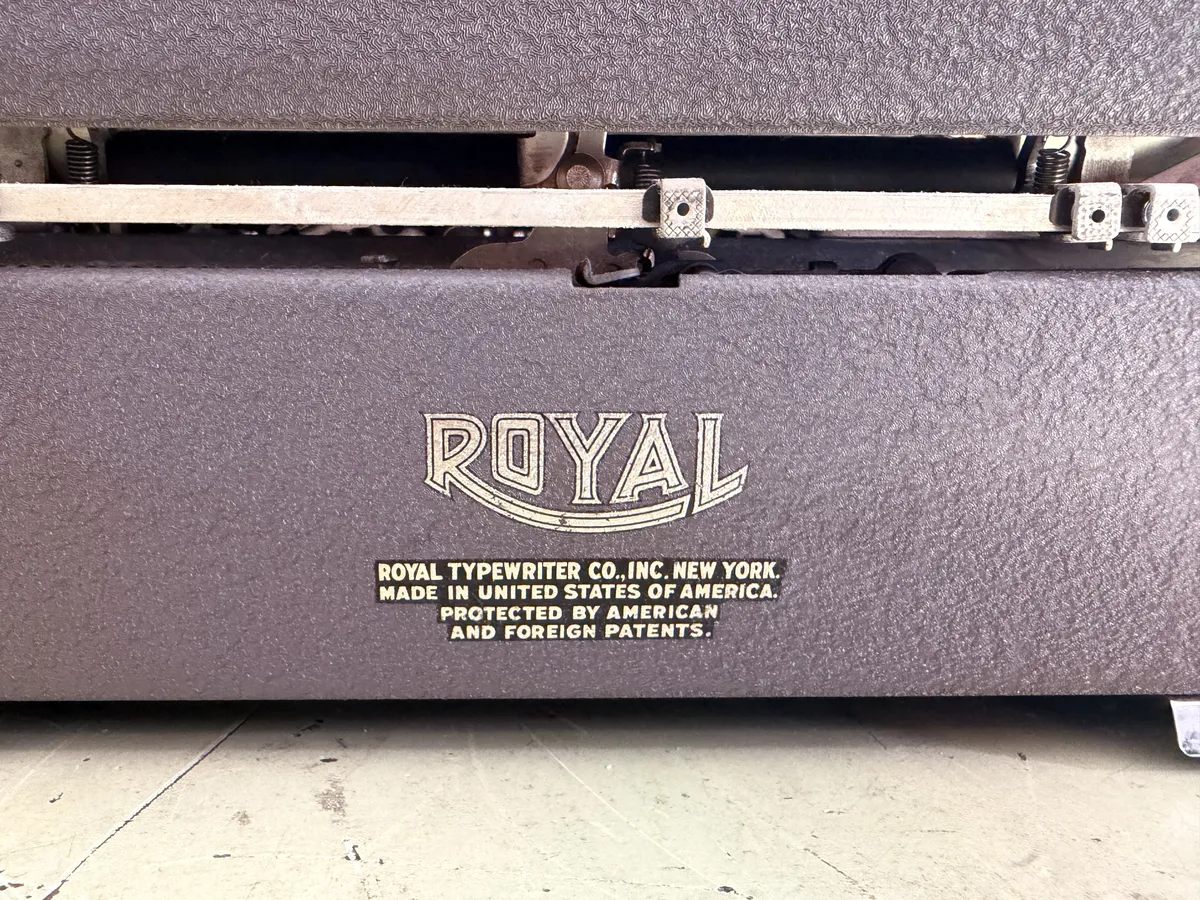
I don't want to restore that any more than I want to restore the cigarette smoke smell to the Royal.
Keep the Typewriter
And after saying all of this, here's the strange part. I still love 1955. Or at least I love pieces of it.
Put that old Royal on my workbench and I'll happily spend hours cleaning the thing. I'll flush seventy years of accumulated junk out of the segment. I'll scrub the type slugs. I'll adjust whatever is rubbing. I'll replace something that broke. I'll put a sheet of paper into it and listen for that wonderful little bell. And when I'm finished, I'll probably sit there for a minute and admire it, because it deserves to be admired.
There's a phrase I've complained about once or twice on this blog, and that phrase is fully restored.
I don't like the phrase and I don't use it, partly because I don't really know what it means. Restored to... what?
If I get a machine from 1955 working beautifully again, I don't need to put seventy years of cigarette smoke back into it because that was original too. I need to understand the machine well enough to know what was good, what broke and what needs to change.
Preservation is not restoration.
Maybe that's not a terrible way to think about a country either.
There are things America knew how to do in 1955 that I desperately wish we still knew how to do. We knew how to make some extraordinary things. We had a stronger labor movement. We believed more readily in public investment. We had repair shops and skilled tradespeople and weird buildings. There was an approach to creation that utterly lacked cynicism that I find almost painfully beautiful when I open one of these old machines.
Bring that stuff back. Please.
Let's figure out how to rebuild some of the community we've lost without rebuilding the walls that kept people trapped inside it.
The racism can stay dead. The misogyny can stay dead. The closet can stay dead. Christian cultural supremacy can stay dead. None of those things is required to build another beautiful typewriter.
We don't have to hate the past, and we don't have to worship it either. A country, like a typewriter, doesn't have to be returned to its original condition to be worth preserving.
You just have to understand it well enough to know what was beautifully made, what eventually broke, and what never worked properly in the first place.
Image Credits
- Olivetti Lettera 22 — Paul Lowry, Wikimedia Commons, CC BY 2.0: https://commons.wikimedia.org/wiki/File:Olivetti_Lettera_22.jpg
- WPA mural, Cohen Building, Washington, D.C. — Carol M. Highsmith, Library of Congress; no known restrictions on publication: https://www.loc.gov/item/2010720418/
- Old-style McDonald's with Golden Arches and Speedee architecture — Infrogmation of New Orleans, Wikimedia Commons, CC BY-SA 3.0: https://commons.wikimedia.org/wiki/File:GentillySpeedyMcDonalds.jpg
- 1955 Royal Quiet De Luxe — Texbodemer, Wikimedia Commons, CC BY-SA 3.0: https://commons.wikimedia.org/wiki/File:RoyalQuietDeluxe.JPG
- Detroit UAW-CIO members in the Labor Day parade, 1942 — Arthur S. Siegel, Farm Security Administration/Office of War Information Collection, Library of Congress; public domain/no known restrictions: https://www.loc.gov/pictures/item/2017837317/
- Typing address labels at the W. Atlee Burpee Company, Philadelphia, 1943 — Arthur S. Siegel, Farm Security Administration/Office of War Information Collection, Library of Congress; public domain/no known restrictions: https://www.loc.gov/pictures/item/2017849979/


