seize the means of communication (and write the manifesto on a typewriter).
When someone, anyone at all, sits down at a typewriter, they’re doing something I find extraordinary. They’re preparing to put something into the world, something new. They are creating. A finger presses a key; a mechanical thing does its thing; the force of that small act is magnified onto a page. Then the page can be carried, read, discussed, pulled apart, combined with other rhetoric, and disseminated. The word leaves the person who made it. It becomes available to a larger public.

That’s what makes it seem (to me) like the typewriter is uniquely political. It is proletarian in a rather literal sense... it is a machine that works. Things move. Metal strikes metal. A key goes down and a typebar comes up and hits something. The carriage advances. The bell rings. The machine clatters and bangs and produces something through its physical labor. Compared with the smooth glass and invisible processes of the computer, there is something almost indecently mechanical about it. Épater la bourgeoisie. Write the manifesto on a typewriter.
But the typewriter is also an extension of the printing press, a means by which a person can reach a literate public with a message. Politically meaningful things have been done with typewriters because politically meaningful things have been done with words. Testimony has been preserved. Arguments have been made. Memory has been recorded. Poetry has been poured out. People have persuaded, proselytized, prophesied.

Now, I don’t mean to suggest a typewriter as a tool is politically “pure” or some such nonsense. No tool is. And ones that have been meant for good are all too often co-opted by those who wish to promote control and fear. The political right has weaponized communication, institutions, and technology just as it has weaponized other things that can be used for collective life. A typewriter can serve corporations, states, bureaucracies, reactionaries, and propagandists as readily as it can serve a novelist, an organizer, or a person writing a letter that changes someone’s mind.
And of course that doesn’t make the tool meaningless. It makes the question of use more urgent. What do we do with the tools that we have? What do we make with them? Who gets to repair them, understand them, borrow them, and put words into circulation through them?
Who Owns the Tool?
There is a politics to the word, then, but also a politics to the machine. Who gets to speak matters. So does who controls the tools we use to do it.
Because control of a tool is also, in some small but meaningful way, control over what we can make with it. A tool that can be understood, repaired, passed from one person to another, and kept in service asks very little permission from anybody. And in the case of a typewriter, what it makes is language. That language can go anywhere.

There's a strange little contradiction in that. The machine itself can belong entirely to the person who strikes the keys. The words do not behave nearly so well. Once a word is written, it has the potential to move well beyond its author. It can be shared, contested, preserved, reread, discovered by someone it was never intended for, and made part of a larger world. Private letters become public documents. Diaries become books. Notes become archives. Things written for one person end up being read by thousands. A page can survive the person who wrote it and the person for whom it was intended.
So "ownership" isn’t really the interesting thing. The typewriter can be privately owned and completely under one person’s control. But what comes out of it can enter public life almost immediately. The machine may be private, but the word itself is considerably harder to contain.
That distinction matters now because we are increasingly taught to confuse access with ownership, and convenience with freedom. So much of modern life is governed by the subscription model. We are allowed to use things for as long as we keep paying. We are given devices that cannot easily be opened, programs that can disappear, services that can change their rules overnight, and tools that require a company’s ongoing permission to function as promised. We are told that this is progress because it is seamless.
But seamlessness has a politic. Corporate control engenders disposability and passive consumption. When a thing breaks, we are encouraged to replace it. When a feature changes, we are expected to adapt. When a company decides the terms of use, we are meant to accept that decision as the natural order of things. We become users rather than makers, customers rather than caretakers, subscribers rather than owners of our own attention.
The Uses of Friction
A typewriter is necessarily cumbersome. Having become used to computers and instant communication, I sit down to type and feel that cumbersomeness immediately. A typewriter must be loaded with paper. Its keys require pressure. Its errors cannot be invisibly revised away. The page is finite. The carriage moves and the bell sounds. All of this is to suggest the machine makes demands on the person using it. I've found it's useful being forced to work inside that specific set of demands.
Because isn't it within the limits that we so often find ourselves free? The typewriter’s resistance does not automatically make a person wiser or their words more meaningful. But it does interrupt the fantasy that writing is frictionless, costless, and without consequence. It asks the writer to slow down. It asks for attention. It translates the act of choosing a word into something physical.
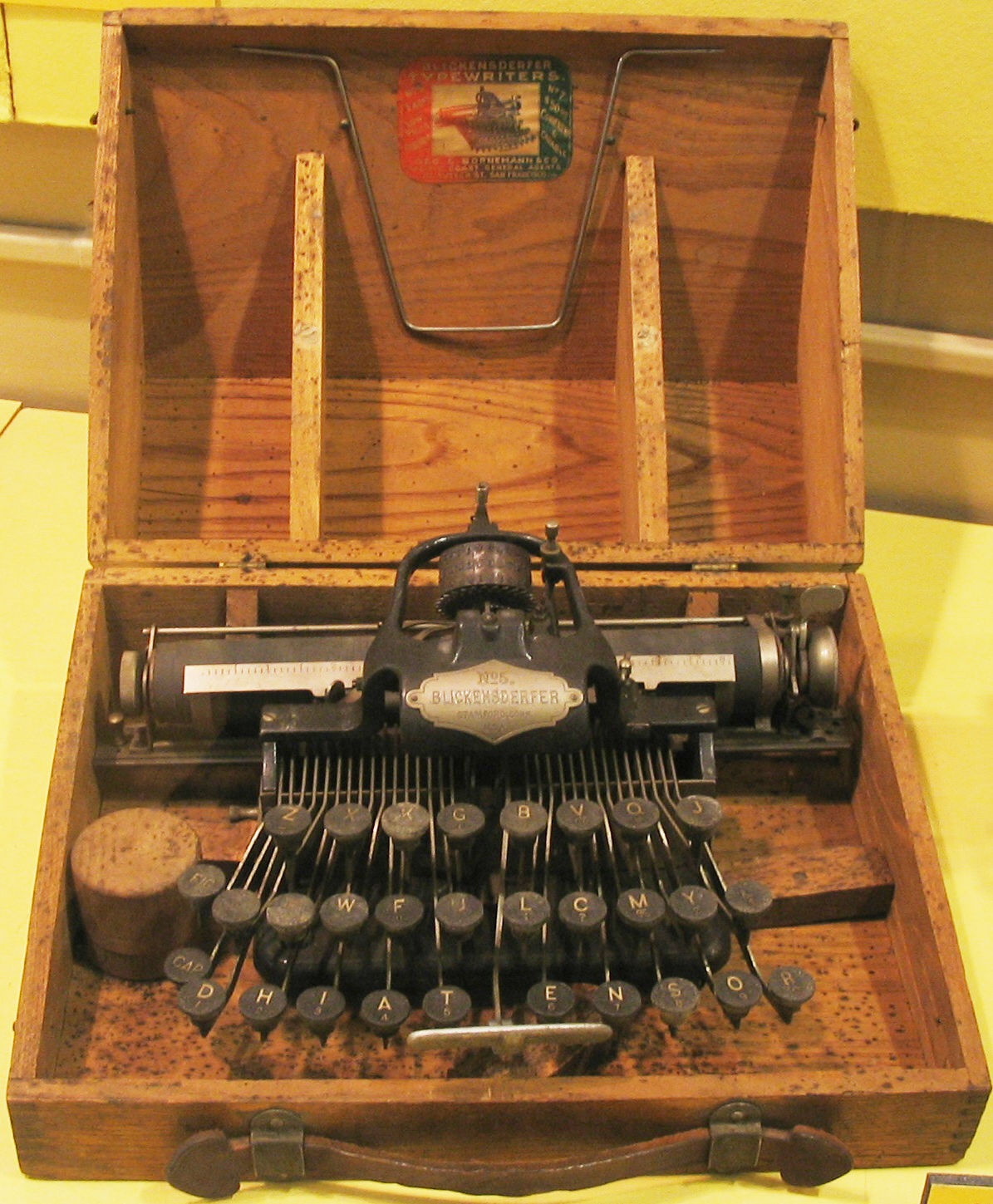
The force of the strike, the visible correction, the end of the line… these are not merely inconveniences. They are reminders that language is made. It is embodied, and it carries responsibility. And maybe there is something important in having a tool that lets us see all of this happening. You can see how the machine works. You can see what you did wrong. You can see the correction. You can open the thing up and, with some patience, understand why it does what it does. None of it has to be magic.
But the value of a durable tool isn't only in what happens while we're using it. Durability means that the thing remains after we're finished with it.
What We Keep
I once encountered a typewriter whose history led me, through a name and a series of connections, back to the family of the woman who had used it. She had written novels on that machine. When I was able to reunite the typewriter with her daughter, the object became more than an artifact of another era. It became a visible connection to creative work, memory, and a person who was no longer there to explain herself. It was a sublime experience for her, just shock and pain and relief and wonder.
I don’t wish to make too much of that story. It belongs first to that family, not to me. But it taught me something important. These tools have the ability to reach across time. They can carry the past and also write the future. To repair a machine and keep it working is not simply to worship the old or to pretend that history was better. It is to refuse the idea that an object, and the human labor bound up with it, becomes worthless merely because a newer fuckin’ thing exists.

And the lesson cannot simply be that every person should become a typewriter collector or something. God help us. The point is not possession of the tool as a rule. The point is a culture in which durable tools can remain in use and in reach.
But keeping things does not have to mean hoarding them. And ownership, by itself, isn't much of a political vision. Communists have made a politics of that idea; the earliest Christians made a religious community of it. Both, in radically different contexts, asked what might happen if possession were subordinated to need and common life.
That means ownership, sure. But it can also mean libraries. Repair shops. Lending systems. Workshops and co-ops. Places where things are shared and where the knowledge required to keep them working is shared along with them. The alternative to corporations owning everything we use is not necessarily that every individual person has to own everything instead. A typewriter can be owned by one person, borrowed by another, maintained by many, and used to produce words that belong to public life.
And so we end up more or less where we started. Someone sits down at a typewriter and begins to write.
The political possibility begins there. Not because the typewriter is magical, and not because a machine alone can defeat corporate power. It begins because somebody has a tool in front of them that they can use, understand, maintain, and perhaps hand to somebody else. And what they make with that tool can leave the room.
The question is not whether using a typewriter makes us morally better people, because obviously it doesn’t. The questions are harder than that. What are we paying for convenience? What control have we surrendered? What systems do our habits sustain? What kind of public world do our tools help create?
The typewriter does not solve those questions. It places them, literally, in our hands.
Image credits: Ralph Steiner/Clarence H. White School of Photography, Library of Congress; Library of Congress Prints & Photographs Division; Underwood & Underwood, Library of Congress; Ian Ruotsala; Harris & Ewing Collection, Library of Congress. Images are public domain or carry no known restrictions on publication.